


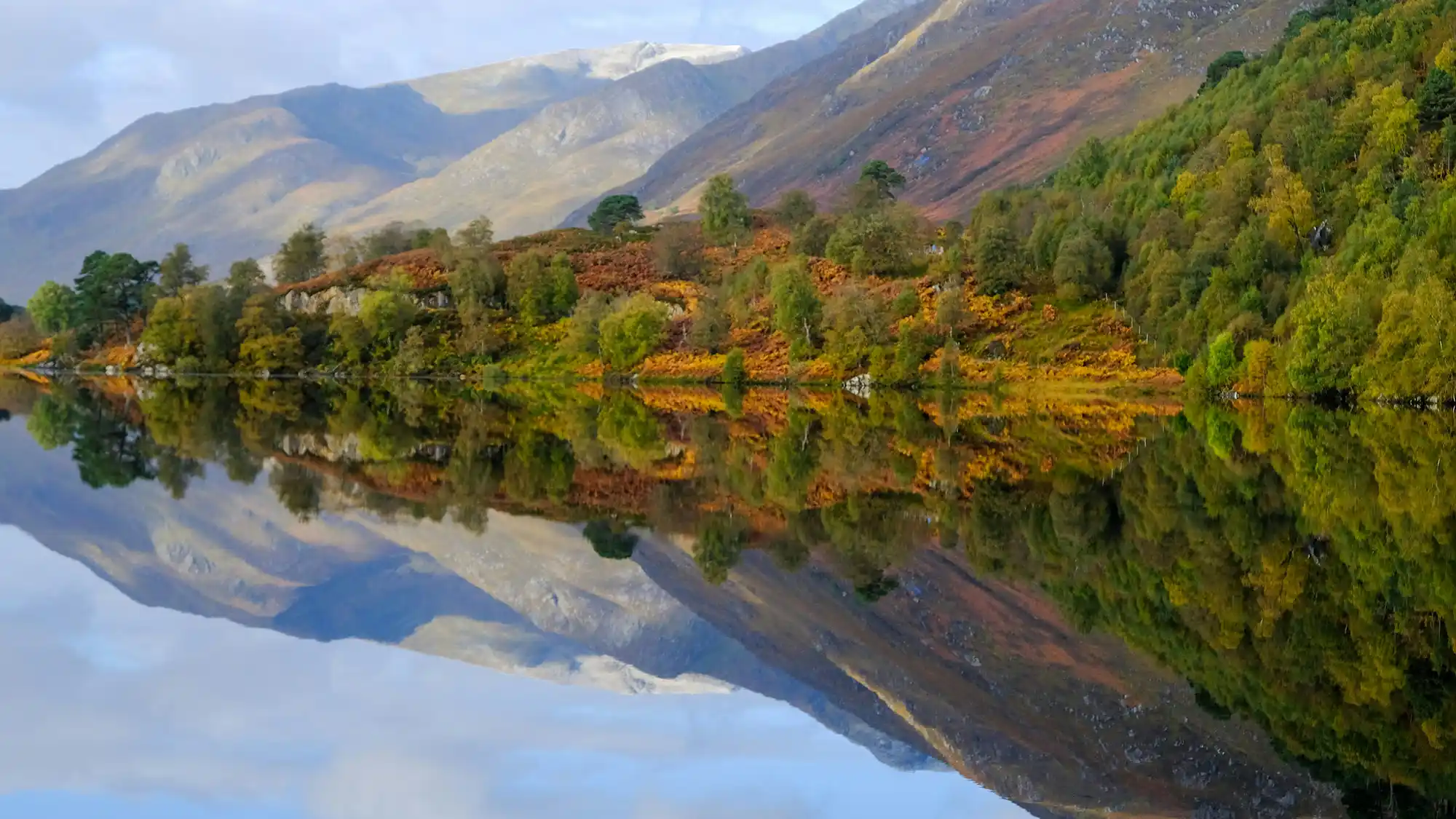

Central Highlands of Scotland — Glen Cannich, Moriston and Shiel


Landscape level
Score
The Affric Highlands initiative is a 30-year, landscape-scale rewilding partnership across the central Highlands of Scotland. It aims to restore ancient Caledonian pinewoods, peatlands, rivers, and montane habitats across hundreds of thousands of hectares, re-establishing natural ecological processes and a thriving nature-based economy. Through large-scale forest regeneration, peatland rewetting, river and pond restoration, deer management, and innovative community enterprise, the project seeks to create one of Europe’s most ambitious rewilded landscapes.
After centuries of deforestation and overgrazing, much of the Scottish Highlands has become ecologically impoverished. The Affric Highlands, known for remnants of ancient Caledonian pinewood and dramatic glens, still hold significant biodiversity potential. Traditional land uses such as sheep farming and forestry have left extensive bare hillsides, but rural depopulation and changing economics create opportunities for ecological and social renewal. The partnership unites multiple landowners to rewild the landscape, reduce deer densities, and rebuild community prosperity rooted in nature.


The Affric Highlands initiative restores ecological processes across forests, peatlands, rivers, and grasslands through natural regeneration, hydrological restoration, and selective rewilding interventions. It reduces deer pressure to enable forest recovery, rewets peatlands for carbon capture, and strengthens habitat connectivity for wildlife movement. At the same time, it establishes a thriving nature-based economy, linking rewilding with tourism, education, and carbon markets to build resilient local communities.

Across the Affric Highlands, interventions are being implemented through a landscape-scale partnership in which multiple landowners agree to coordinate nature recovery across a very large, contiguous area. The approach is explicitly process-led, aiming to restore a mosaic of woodland (including ancient Caledonian pinewood), peatland, scrub, sub-alpine grassland, wetlands and river corridors, and to reconnect these habitats so that wildlife can move through the landscape more freely. Rewilding Affric Highlands coordinates the coalition and provides advice and support, while participating landowners choose which interventions to apply on their own land.
Woodland recovery is being pursued through a combination of natural regeneration and targeted planting. Efforts focus on reversing centuries of felling and overgrazing by deer and sheep, restoring ancient Caledonian pinewood, and increasing tree cover along natural corridors such as rivers and mountain ridges. Where local seed sources remain, interventions support natural regeneration of Scots pine and native broadleaved species, with deer management used to protect young growth. Where seed sources are absent or natural regeneration is not feasible, native trees are planted to connect isolated forest fragments. Montane tree species are being grown from seed and then returned to mountain areas specifically where natural regeneration cannot occur. In addition, non-native plantations are being selectively replaced with native forest to improve habitat quality and continuity.
Peatland restoration is being implemented by first mapping drained and degraded peatlands and then rewetting them so they can function again as carbon sinks and wetland habitats. The rewetting work is also intended to increase the peatland’s capacity to store water upstream, contributing to flood and drought mitigation by retaining water in the landscape.
Herbivore and deer management are central implementation components because large carnivores are absent. Grazing by carefully selected large herbivores is being used deliberately to accelerate plant diversity and create soil disturbance that supports habitat complexity. At the same time, deer numbers are being reduced to enable widespread vegetation recovery. A more targeted and ecological approach is being developed through deer population modelling software to better assess and manage deer impacts at landscape scale. Deer culling is also framed as providing carrion that supports other species across seasons.
River and riparian interventions focus on giving rivers more space to function naturally and improving habitat along watercourses. Implementation includes restoring riparian woodland and buffer zones through natural regeneration, removing aquatic barriers, and engaging with stakeholders to encourage coexistence with species such as beaver. River restoration actions described include introducing more meanders to slow flows and increase riparian habitat. Beaver reintroductions are a concrete, implemented measure in this system: in October 2025, Forestry and Land Scotland released a family of five beavers and a beaver pair at two sites on Loch Beinn a’ Mheadhoin within Glen Affric National Nature Reserve, following partnership work with Trees for Life since 2022 and support from the Beaver Trust. The intended functional role of beavers is to retain more water upstream, reduce flood impacts, create deeper and cooler pools beneficial to juvenile fish, and improve water quality by trapping harmful sediments.
Connectivity measures to support wildlife movement are being implemented at a broad scale by reducing fragmentation between landholdings. This includes removing fences and working collaboratively across estates to establish a more contiguous wild landscape. Education and engagement initiatives are described as ongoing, aimed at promoting human–wildlife coexistence, reducing conflict, and building understanding of the benefits of ecological restoration.
A detailed example of site-level implementation is provided for Glen Loyne, a remote pinewood remnant containing 57 ancient Scots pines that was threatened by heavy deer grazing. Trees for Life surveyed the site under its four-year Caledonian Pinewood Recovery Project and identified that previous fencing (installed in the 1990s) did not adequately protect key trees and had been breached by deer. In cooperation with the landowner, Trees for Life created a deer-proof fencing exclosure to protect the most ancient pines and enable seedlings to establish. This involved erecting 1.5 km of new fencing and connecting, extending and repairing existing sections. Due to the remoteness of the glen, heavy-duty materials were transported by helicopter. The fencing is explicitly presented as a temporary but necessary measure to allow natural regeneration until effective landscape-scale deer management can be established.
Governance for implementation is reinforced through formal agreements and memoranda of understanding that bring landholdings into the coalition and establish a basis for coordinated action. For example, Forestry and Land Scotland signed an agreement that brought Glen Affric National Nature Reserve and additional public landholdings (17,604 hectares) into the partnership, expanding the scope for coordinated delivery of woodland, peatland, wetland and river-related restoration actions on public land alongside neighbouring estates.
In the Affric Highlands landscape, interventions also focus on working with private estates, crafting communities and local businesses to develop economic opportunities linked to landscape restoration. Current work includes engaging landowners in rewilding plans and deer management dialogue, supporting local food initiatives such as linking venison supply chains to ecological outcomes, partnering with farming clusters, and strengthening collaborations with existing producer networks. The team is also exploring ways to develop low-impact tourism linked to the landscape, by working with community tourism actors to improve visitor experiences, services and storytelling while maintaining the area’s wild character.


Information not available yet.