


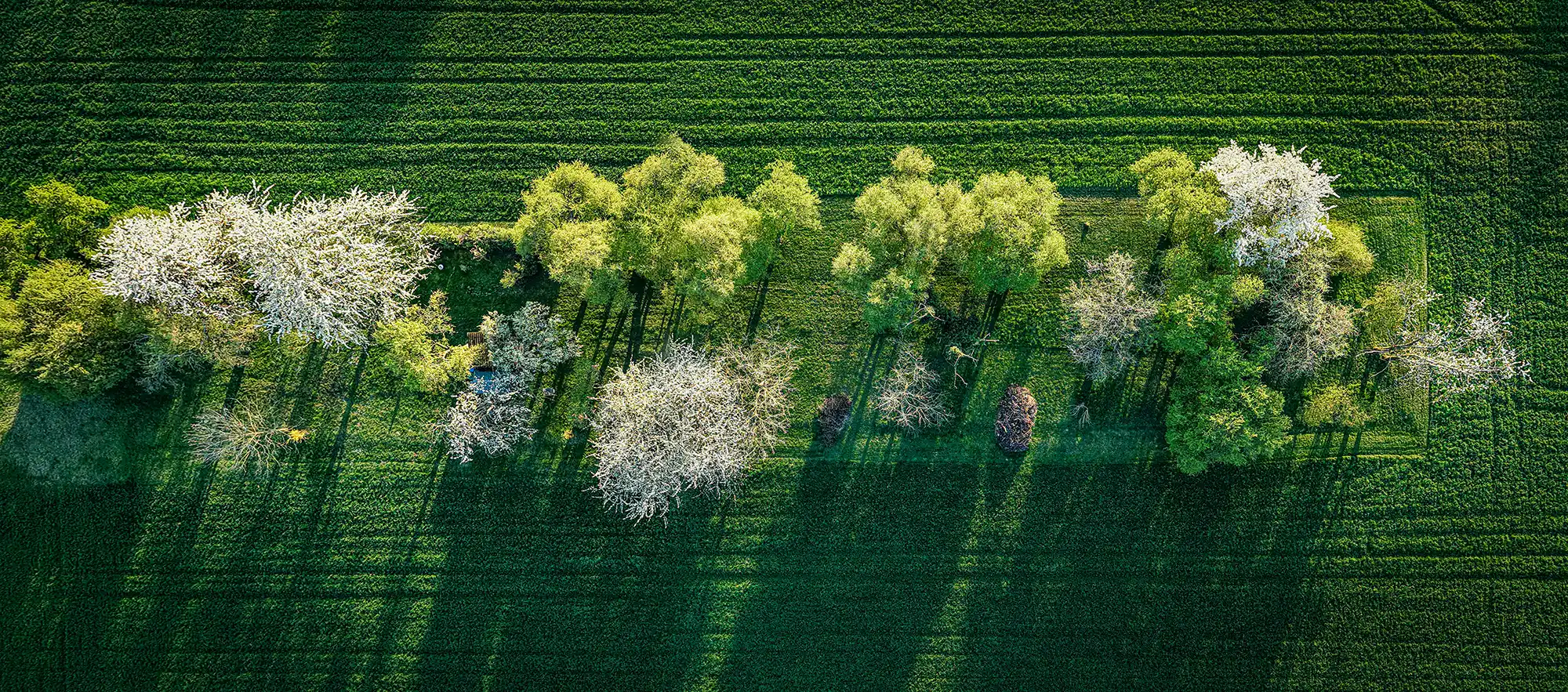

Wakelyns Farm, Suffolk, United Kingdom; Whitehall Farm, Cambridgeshire, United Kingdom

Ongoing implementation

Landscape level
Score
Two UK organic farms have implemented silvo-arable agroforestry by integrating fruit, nut, coppice and timber trees within arable/horticultural alleys. This increased on-farm biodiversity, protected soils, and diversified income. Wakelyns (22.5 ha) uses 56 tree rows with 10–15 m crop alleys and on-site renewable energy; Whitehall (100 ha) established a 52 ha apple-based system in 2009 with 4,500 trees and wide machinery-suitable alleys. Reported outcomes include richer wildlife (e.g., 43 bird species), reduced wind erosion, improved soil function, and viable farm enterprises.
In largely monocropped landscapes, both farms sought to balance productivity with environmental protection and climate resilience. Wakelyns aimed to reduce external inputs, build soil fertility and habitats, and increase system self-reliance (solar and woodchip energy). Whitehall sits on wind-erosion-prone fen peat (“Fen Blow”) and required a commercially viable solution compatible with tenancy constraints; agroforestry was chosen to protect soils, diversify outputs and sustain organic arable production.


Both farms integrated tree rows within arable systems to deliver wind shelter, microclimate moderation, soil organic matter inputs, and year-round habitat. Wakelyns planted mixed fruit, nut, willow coppice and timber species in 56 rows with 10–15 m crop alleys, complemented by pollarding and legume covers, and powered operations with solar and woodchip. Whitehall established 4,500 apple trees over 52 ha (100 trees/ha) with 27 m alleys, N–S row orientation, and a 3 m nectar understorey to suppress weeds and support beneficial insects, maintaining arable operations with minimal yield trade-offs.

At Wakelyns Farm in Suffolk, organic silvo-arable agroforestry was implemented by establishing rows of trees within cropped land, integrating fruit, nut, willow coppice and timber species with arable or horticultural production. The system was laid out as 56 tree rows, with cropping alleys of approximately 10–15 metres between rows. The intervention physically combined annual cropping with perennial tree cover to create on-farm shelterbelts and diversify habitat structure in an otherwise largely monocropped surrounding landscape. The trees were intended to provide wind protection for crops, while root systems and leaf litter were used to build soil fertility over time. Soil fertility improvement was further supported through leguminous ground cover crops such as clover. Alongside new planting, older trees were actively managed through pollarding (pruning the top and branches to stimulate new growth), with the stated aim of improving carbon sequestration potential across the farmed area. Implementation emphasised minimising external inputs, including reliance on on-site and local resources for energy via solar panels and a woodchip boiler. The main stated limitation affecting implementation was fixed land availability, constraining the extent to which interventions could be expanded.
At Whitehall Farm near Peterborough (Cambridgeshire), tenant farmers established a field-scale silvoarable orchard to address severe wind erosion on cultivated fenland peat soils (“Fen Blow”) while maintaining commercial arable production under an organic, stockless system. A key implementation obstacle was short land tenure, which can be as little as 3–5 years in the UK and is considered a major barrier to planting long-lived trees. This was overcome by negotiating a 15-year tenancy renewal, providing a sufficient timeframe for trees to generate an economic return.
Following research to select a suitable tree enterprise, the farm planted a mixture of thirteen apple varieties (fruiting and juicing types) on semi-dwarf rootstocks across 52 hectares in autumn 2009. In total, 4,500 trees were planted, but the low-density design meant trees occupied only about 4 hectares (around 8%) of the planted area, leaving approximately 48 hectares (about 92%) available for continued arable cropping between rows. Tree density was approximately 100 trees per hectare within the silvoarable system, substantially lower than conventional UK orchard plantings (noted as around 1,000 trees per hectare). This design choice reduced establishment and fixed costs, avoided the need for specialist orchard machinery, and limited yield trade-offs from shading.
The orchard was engineered to function as both a productive tree crop and a windbreak network. Rows were oriented north–south to minimise shading impacts on companion arable crops and to interrupt the predominantly south-westerly winds driving erosion across the flat fenland landscape. Tree height was managed through pruning to approximately 3–4 metres, balancing reduced shading with the goal of disrupting wind flow. The spatial layout comprised 3-metre spacing between trees within rows and 27-metre cropping alleys between rows, providing a 24-metre access width compatible with large arable machinery and enabling standard field operations to continue.
To support the organic system without pesticide use and to manage under-tree competition, a 3-metre understorey strip was established beneath the tree rows using a nectar flower seed mix including clovers, vetch and perennial wildflowers. This understorey was intended to suppress weeds under the trees and provide habitat and resources for pollinators and beneficial insect predators, supporting both apple production and wider pest regulation within the organic cropping system.


Information not available yet.