


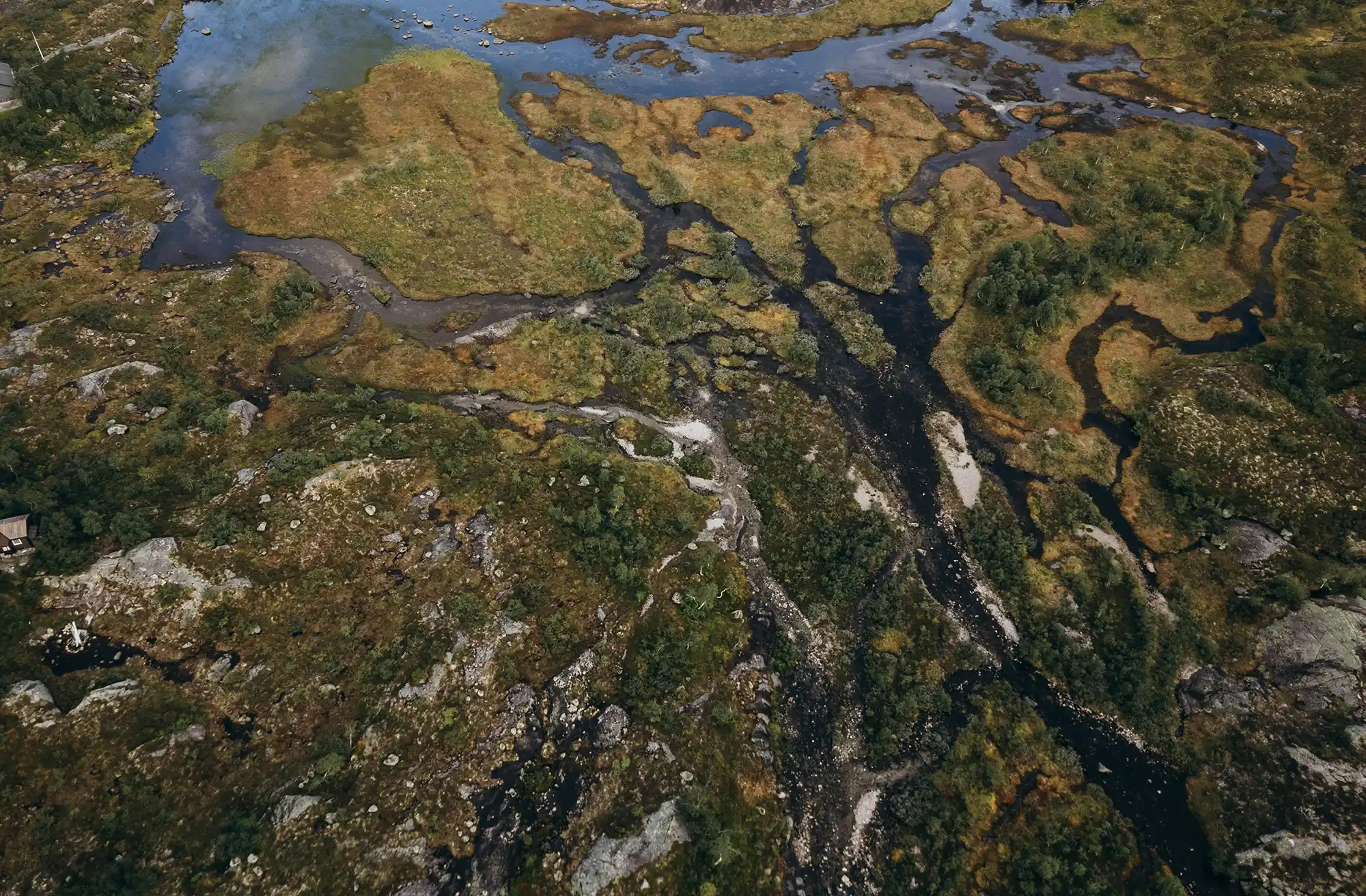

Landemarais, Parigné, Ille-et-Vilaine, Massif Armoricain, France

Project ended

Pilot site
Score
The Landemarais peatland, a 26-hectare protected site in north-west France, faced biodiversity decline due to the domination of Carex paniculata who formed a near-monospecific vegetation. Within the Care-Peat project, restoration actions tested in Landemarais focused on removing Carex-dominated vegetation and establishing Sphagnum moss using transplanted patches and floating mats, with the aim of supporting the recovery of peatland carbon sink function. Early monitoring results indicate improved CO₂ sequestration and increased ecological diversity.
Many peatlands in north-west Europe have been degraded by human activities such as drainage for agriculture, forestry, or extraction. Once drained, peatlands can shift from carbon sinks to carbon sources, releasing significant greenhouse gases. In the Landemarais peatland, dominant species like Carex paniculata reduced biodiversity and accelerated carbon loss. The Care-Peat project sought to reverse this degradation by testing restoration practices that could be scaled up across the region, with a focus on improving carbon storage alongside biodiversity.


Restoration in Landemarais involved peat stripping, removal of the species Carex paniculata, and reintroduction of Sphagnum moss to improve biodiversity and restore carbon storage functions. Monitoring showed that the restored area functioned as a CO₂ sink for most of the measuring period in the first year, confirming the positive impact of the interventions.

At the Landemarais peatland (Parigné, Massif Armoricain), restoration works were implemented on a 26 ha site owned and managed by the Ille et Vilaine County Council and designated as a Sensitive Natural Area. The intervention targeted areas dominated by Carex paniculata, where vegetation had become near-monospecific and was considered likely to promote carbon losses.
Physical restoration measures combined shallow peat stripping with active Sphagnum establishment. Vegetation and the top 10–20 cm of peat were removed in two plots of roughly 20 m x 20 m. Excavated peat, containing Carex paniculata seeds, was relocated to a wooded buffer strip between a lateral canal and the peatland to reduce reinvasion risk from the seed bank. Two zones were selected to differ in water table conditions so that Sphagnum performance could be compared under different wetness levels.
To reinforce long-term peat-forming processes and carbon storage potential, Sphagnum was transplanted from intact parts of the site and installed in February 2023 using two methods adapted to hydrological conditions. In less aquatic areas, six dense Sphagnum patches were created as 50 cm x 50 cm squares stabilised with cotton string and anchored using bamboo sticks that both held the string and supported the moss. In permanently aquatic areas, floating Sphagnum mats were constructed from linked cork frames (50 cm x 50 cm, with an internal cut-out forming a frame) tied with cotton string and lined with a hemp net; Sphagnum was placed within the netted “basket” to float and establish.
Site access and monitoring were integrated into implementation to avoid damaging sensitive peat surfaces. Removable walk-boards were built and installed by CD35 in February 2023, at the same time as collars for greenhouse gas measurements. Monitoring began in March 2023 and used the walk-boards to reach plots without trampling. Measurements were taken in restored areas on bare peat (n=3) and on Sphagnum patches (n=3), and in a control area on bare peat (n=3) and Carex paniculata tussocks (n=3). When feasible, nets were used to test ecosystem responses under different radiation levels.
Early observations indicated rapid colonisation of stripped surfaces by characteristic colonising species (including Juncus spp., Hydrocotyle vulgaris and Drosera rotundifolia). Sphagnum survived the first year and showed signs of expansion beyond the initial patch footprint. Initial CO2 flux monitoring suggested that, despite high CO2 uptake, Carex paniculata areas frequently acted as a CO2 source due to high ecosystem respiration, whereas the restored area functioned as a CO2 sink for most of the measurement period during the first year. Reported implementation conditions also highlighted sensitivity to drought: 2023 was not overly dry, supporting Sphagnum survival, but longer-term success was noted as dependent on the frequency and intensity of droughts in subsequent years.
Stakeholder engagement was built around the pilot site as a practical demonstration. A workshop held in October 2023 convened participants ranging from site managers to private companies, including stakeholders involved in managing large peatlands in north-west France. Discussions focused on operational issues central to replication, including raising water levels, monitoring carbon fluxes, and working with landowners (notably farmers), with the pilot used as a basis for knowledge transfer and future project development.
Beyond the site-level works, the project partners formalised continued cooperation after the end of Care-Peat (December 2023) through a “Care-Peat Project Alliance” under a Eurosite thematic twinning framework. This structure supported ongoing exchange through thematic support groups and regional platforms, and the project’s practical experience was disseminated as replicable good practice via PANORAMA – Solutions for a Healthy Planet.


Information not available yet.